
Whenua
On the places that nourish us

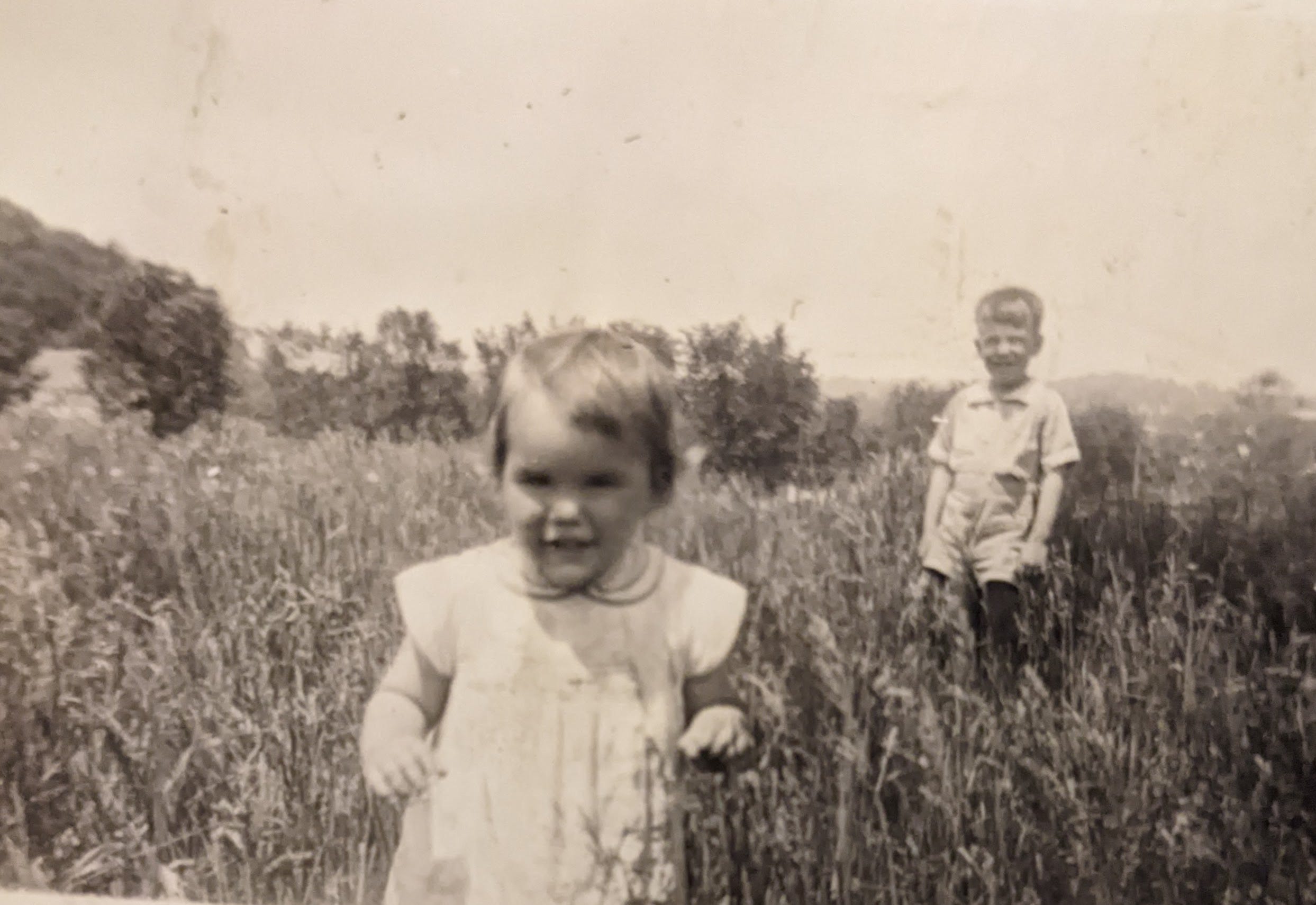
(My mother with her brother looking on)
Standing in the empty center of the house, I watched dust drift through the light from a bare window. Cobwebs stretched across corners no one had reached in years.
Four buildings had stood on this stretch of land, across three generations. The 1861 farmhouse, where my grandparents moved with my mother as she was entering her junior year in high school in the 1950s. The barn beside it, older still, standing until it came down around 1990. The house my father built on a wooded ridge between two ravines after he and my mother divorced in the 1970s — the house where I grew up. And this one: the house my mother built for herself, on the exact ground where the barn had stood, not long after her own parents were gone.
Now it was empty too. My brothers and I had spent days sorting through what was left — ninety-one years of a life, much of it in boxes that hadn’t been opened in decades. Some things were useful. Most weren’t. Things that had expired, broken, been forgotten. And still, item by item, I found myself wondering how many of them had once carried meaning far beyond their use.
A place can do that to us.
I’ve been thinking about a Māori word: whenua. It can mean land or homeland. It can also mean placenta. The placenta is the place that nourishes us before we enter the world. Whenua suggests our relationship to land might be understood the same way — not as scenery, but as sustenance.
Places nourish us. The houses where we grow up, the neighborhoods we roam, the schools, the churches, the places where we fall in love and raise children and grieve — they give us more than shelter. They give us memory, relationship, routine, story.
They become part of us.
I felt this reading my mother’s StoryWorth account — a project that sends elders weekly writing prompts and compiles their answers into a book. She mostly ignored the prompts. Instead she wrote about the places she had lived: Hocking Hills, Parma, Lakewood, Gahanna, Clintonville, Canal Winchester. Every entry was full of people, pets, the texture of ordinary life in each one.
At first I thought she’d simply skipped the assignment.
Now I think she answered a better one. If she told us where she had been, she was telling us who she had become.
We don’t usually announce that a place has become part of us. We just know it. For me, trails still wind through woods I could walk with my eyes closed. Fields change through the four seasons, and I can still picture them in my mind’s eye. Kitchens where I could reflexively find the can opener. A table where extended family gathered to play cards.
And sometimes an object carries the place with it — which may be part of what I was seeing in those boxes. A thing can be useless and still matter. A box can sit shut for twenty years and still hold a piece of someone’s story.
That doesn’t mean we need to keep it.
Maybe one of the harder tasks of growing older — of any of us growing older — is learning the difference between preserving a memory and preserving an object. We don’t have to keep the house to keep what the house gave us. The nourishment already happened.
This is where the placenta becomes more than a striking word origin. Its purpose was never permanent attachment. Its purpose was nourishment sufficient for becoming separate. Perhaps places work the same way. We leave our childhood homes. Our children grow up and leave us. Parents die. Neighborhoods change beyond recognition. Sometimes the building itself disappears, torn down, built over, gone.
None of that means the nourishment was wasted. It may only mean the place finished its work.
I think about this looking at my own life. Ohio is in me. The houses I grew up in are in me. The places where I raised my children, worked, struggled, and loved have become part of the person I’m still becoming.
We leave more than houses. We leave schools, first apartments, churches, jobs, whole seasons of ourselves. We leave relationships. What we learned from loving one person can shape how we love the next. The version of us that lived through it disappears, but something of it doesn’t.
Maybe this is one of the quiet tasks of becoming — learning what to carry forward and what to release. We don’t need every object, every room, every place preserved exactly as it stood. Sometimes the most honest thing we can do for a place that nourished us is let it become our history instead of insisting it remain our present.
My mother is leaving her house. She isn’t leaving the girl who moved into that farmhouse the summer before her junior year. She isn’t leaving the young mother who wrangled three sons in the house on the ridge, or the woman who later built something new for herself out of a cleared field where a barn used to stand. Those things are already in her.
(Not the actual Ohio barn, but for some reason I enjoy painting barns!)
We don’t just live in places. Places live in us.
Standing in that empty house, dust settling in the light, I understood what I was really looking at. Not four buildings. Not a tract of land. The last tangible thread tying my mother, my brothers, and me to the ground that raised us — and proof that the thread was never stuck in the ground at all. It runs through all of us.
I love this. It is not easy to figure out what exactly to hold onto, but I definitely feel the legacy piece of this.
Thank you for sharing this meditation, David. Have you had the experience of moving to live in a place where you did *not* experience whenua -- or even experienced the opposite? A place that drained and sapped your life force?
I've experienced both as an adult, and the contrast could not have been more pronounced for me.